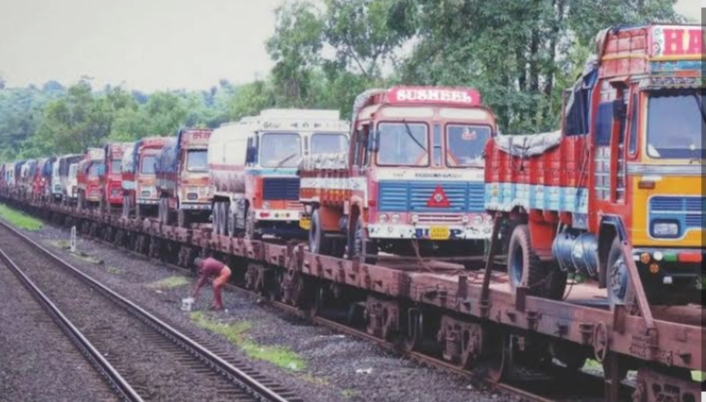
Northern Railway has implemented a new freight rate structure for Roll-on/Roll-off i.e. Ro-Ro traffic with the objective of making freight movement more affordable, transparent and competitive.
Talking about Ro-Ro, in simple terms it is a transport service in which trucks or commercial vehicles loaded with goods are directly driven onto specially designed open flat railway wagons on their wheels and are directly driven off at the destination.
Under the new policy, the charge will be ₹1.45 per tonne-km for distances up to 750 km, a linear rate reduced from ₹1.45 to ₹1.30 per tonne-km for 750 to 2000 km, and ₹1.30 per tonne-km for distances over 2000 km.
The minimum chargeable weight has been fixed at 45 tonnes or the actual gross vehicle weight, whichever is higher, and the minimum distance at 50 km. Terminal charges, GST and other applicable charges will be payable as per existing rules.
Several old restrictions have also been removed in this revised policy for the convenience of customers. Busy Season Surcharge and Development Charge have now been completely abolished, which will give customers an additional benefit of about 20 percent. Earlier it was mandatory for transporters to commit traffic and book for a round trip, along with a five per cent penalty on shortfall. All these conditions have been abolished in the new policy. One-way Ro-Ro operations will now also be permitted.
Customers will get direct and substantial savings from this revised policy. For example, on the 241 km Bari Brahmana–Bijbehara route, the freight has reduced from ₹20,969.34 to ₹14,222.25, resulting in a saving of ₹6,747.09 i.e. 47% per truck.
This new rate structure will provide several direct benefits to industries and transporters. The biggest benefit is the reduction in transportation cost, which will make sending goods by rail more economical compared to road. This will reduce the pressure of heavy vehicles on national highways, reduce road accidents and traffic jams, and help the environment by reducing carbon emissions. This is especially useful because Jammu and Kashmir is a hilly region, and traffic jams occur on the national highway during the rainy season. With Ro-Ro service, loading and unloading time for goods will be reduced, turnaround will be faster and timely delivery to industries will be ensured.
Earlier, Railways used to provide 3 hours of free time for loading, which has now been increased to 6 hours, and 3 hours of free time will also be given for wharf clearance. This new policy will not only give existing industries better access to national and international markets, but will also develop new freight loading sources, thereby accelerating regional industrial growth. The special haulage rate on the New Rewari–New Palanpur section of DFCCIL (Dedicated Freight Corridor Corporation of India Limited) will remain unchanged.
Senior Divisional Commercial Manager, Jammu Division said, "This revised Ro-Ro policy will prove to be a game changer for Jammu Division. With the removal of BSS and DC, abolition of penalty and committed traffic conditions, and permission for one-way operations, rail freight has now become much more competitive than road. Considering the hilly terrain and highway jam problems during monsoon, this service will bring great relief to industries. Our effort is to connect transporters from Bari Brahmana and other industrial areas with this facility and give new momentum to regional trade."
Any trader, farmer or road transport organization in Jammu & Kashmir who wishes to avail this facility under the new policy can contact the office of the Senior Divisional Commercial Manager, Jammu.
Railways believes that this rationalized freight system will promote Ro-Ro traffic and play an important role in developing a sustainable and efficient logistics network in the country.
====